by Pastor Mick Finch
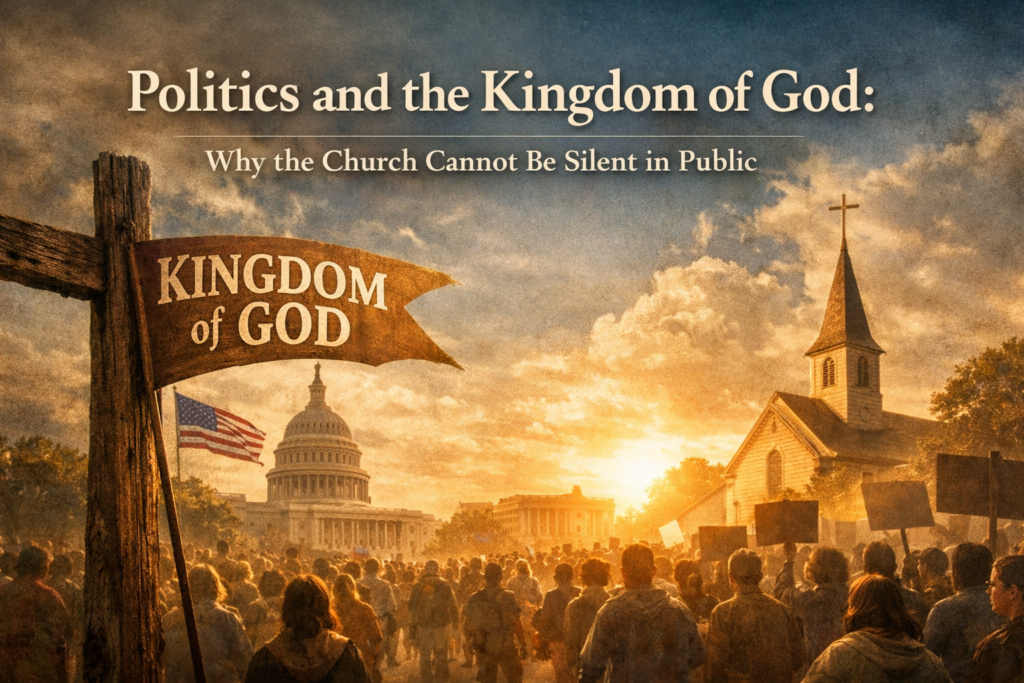
What if one of the church’s greatest mistakes has been treating the Kingdom of God as private?
For far too long, many Christians have spoken as if faith belongs to the soul, the sanctuary, and the afterlife—but not to public life. We have acted as though politics is worldly, while the Gospel is somehow above the fray. But that is not the witness of Scripture. The prophets spoke to public life. Jesus spoke to public life. The early church embodied a public alternative to the ways of empire.
If Jesus came proclaiming the Good News of the Kingdom of God, then we must ask a serious question: what does that Kingdom demand of our common life?
The Kingdom of God Is Not Private
The Gospel is not an escape plan. It is not merely about going to heaven when we die. The Gospel is the announcement that God’s reign has come near in Jesus Christ.
That changes everything.
The Kingdom of God is about how life is ordered under the will of God. It touches bread, justice, truth, dignity, power, mercy, and neighborliness. It is revealed wherever the hungry are fed, the vulnerable are protected, the excluded are welcomed, and the truth is spoken in love.
This is why I believe we must move beyond a “heaven someday” faith and recover the biblical vision of the Kingdom now. The spiritual and physical are not two separate worlds. God’s reign presses into ordinary life. The Kingdom is present whenever human beings experience the concrete realities of shared abundance, healing, justice, and compassion.
Why Politics Matters
I do not mean partisan loyalty when I speak of politics. I do not mean baptizing a party platform or confusing national identity with the Gospel. I reject that entirely.
Christian nationalism is not a faithful expression of Christianity. Neither is white nationalism. Any attempt to weaponize the faith in order to dominate, exclude, or marginalize others is a betrayal of the Good News. The Kingdom of God does not belong to any political party, ideology, or nation. It belongs to God.
But politics still matters because politics is about our shared life. It is about how a society distributes power, protection, resources, opportunity, and dignity. It is about whether people can eat, find shelter, receive healthcare, have their children educated, are treated justly, and whether truth has a place in public conversation.
Those are not concerns outside the Gospel. Those are precisely the places where love of neighbor becomes visible—or fails to.
The Gospel Has Public Consequences
Luke 3 gives us one of the clearest pictures of this. When people ask John the Baptist what repentance looks like, he does not give them vague religious language. He tells them to share their coats. Share their food. Stop exploiting people. Stop abusing power.
That is not abstract spirituality. That is public righteousness.
The Kingdom of God always takes material form. It appears in practices of fairness, generosity, restraint, and solidarity. If our faith never touches economic, social, or civic life, then it has been reduced to sentiment.
Too often, people say, “The church should stay out of politics.”
But out of what, exactly?
Out of feeding the hungry?
Out of defending the vulnerable?
Out of resisting lies?
Out of confronting injustice?
Out of protecting the freedom and dignity of others?
The church should stay out of partisan captivity. Yes.
The church should stay out of idolatry disguised as patriotism. Absolutely.
The church should stay out of the lust for domination. Without question.
But the church must never stay out of public truth-telling.
What Pastors Are Called to Proclaim
Pastors are not called to serve as chaplains to the status quo. We are called to proclaim the Good News of the Kingdom of God.
That means we cannot preach a Gospel that is only personal and never communal. Salvation is not less than personal—but it is certainly more. It is social, restorative, and shared. It concerns how a people learn to live together under God’s reign.
So how do pastors proclaim that Good News in public discourse?
We do it when we refuse to let fear define our neighbors.
We do it when we challenge language that dehumanizes the poor, the stranger, the outsider, or the marginalized.
We do it when we remind our communities that freedom is not simply for ourselves. Freedom is for others. Jesus does not merely free us from sin; he frees us for love, justice, and shared responsibility.
We do it when we resist every version of Christianity that seeks power more than truth, privilege more than mercy, and control more than compassion.
Public discourse is one of the places where discipleship is tested. It is easy to sing about love in worship. It is harder to speak with truth and courage when public life is shaped by fear, distortion, cruelty, and spectacle. But that is exactly where the church must bear witness.
The Church’s Public Voice Must Be Different
The church should not sound like the outrage machine.
It should not echo propaganda.
It should not mirror the cruelty of the culture wars.
The church’s public voice should be marked by humility, courage, clarity, and compassion.
Humility, because we are not the Kingdom—we bear witness to it.
Courage, because truth must be spoken even when it is costly.
Clarity, because the Gospel must not be confused with nationalism, domination, or exclusion.
Compassion, because a public witness without tenderness becomes noise.
And more than anything else, our words must be matched by practice. Love must be practiced, not merely professed. The church has authority to speak publicly only when it is also building communities of prayer, study, welcome, justice, and shared abundance.
The Thinkers Who Help Us See This
Part of my own theological imagination has been sharpened by writers and scholars who take Scripture, history, and justice seriously.
Walter Brueggemann helps us hear the prophetic challenge to systems of power. N. T. Wright presses us to recover the world-shaping meaning of the Kingdom. Gustavo Gutiérrez reminds us that theology must never lose sight of the poor. Dietrich Bonhoeffer teaches that grace is costly and discipleship must take flesh in the real world. Dallas Willard calls us to inhabit the Kingdom, not merely discuss it. Obery M. Hendricks presses the ethical and public force of Jesus’ ministry. These are not voices to imitate uncritically, but they are important companions in the work of discernment.
The Good News Must Be Heard in Public
Politics cannot save us. It is too small a god for that.
But politics is one of the arenas where our loyalties are exposed. It is one of the places where we decide whether neighbor love will remain a slogan or become a structure. It is one of the places where the church either announces good news to the poor or explains why the poor must wait.
The church must not surrender the public square to fear, lies, and domination.
Neither should it surrender itself to the seductions of power.
We are called to something holier than that.
We are called to proclaim that another way of life is already breaking in—a way of life where bread is shared, strangers are welcomed, wounds are tended, truth is honored, and dignity is not reserved for the powerful.
That way of life is called the Kingdom of God.
And the Good News is not merely that it will come someday.
The Good News is that in Jesus Christ, it has already come near.
0 Comments